


EV Charging Permits and Safe Practices
Milwaukee’s Environmental Collaboration Office (ECO), Department of Neighborhood Services (DNS), and Milwaukee Fire Department aim to help you understand permitting requirements and safe practices for installing EV chargers in your home or business. When electrical permits are required, your licensed electrical contractor will apply online to the Department of Neighborhood Services for review.
Electric vehicle charging equipment is permitted by right in any legally established parking space*. Unless part of a legally established electric vehicle charging facility (e.g. permitted and installed prior to October 2021), electric vehicle supply equipment in a residential zoning district shall be for the use of owners, residents and tenants of the property, and shall not be retailed directly to the public.
*On October 12, 2021, the City of Milwaukee enacted an ordinance that updated the Zoning Code to explicitly permit electric vehicle supply equipment (Common Council File #210486). As certified by the City's chief code enforment officer, this ordinance updated the zoning code to permit (“by-right”) electric vehicle supply equipment (EV chargers) in any legally established parking space: Chapter 295-403 (General Provisions, Motor Vehicle Parking, Standards of Design): 3-f-1: electric vehicle supply equipment is permitted in any legally established parking space. Parking spaces that are equipped with electric vehicle supply equipment that meet all other design and placement standards within zoning code count towards any code required motor vehicle parking minimums
Do I need a Permit?
Level 1 chargers that plug into existing wall electrical receptacle do not require a City electrical permit. For further information and recommendations, look under the Safe Practices section.
Installing chargers on the exterior of a locally historically designated property requires the owner to first obtain a Certificate of Appropriateness (COA) from the Historic Preservation Commission (HPC). Historic Presevation staff recomments propery owners avoid attaching the chargers to the exterior of the building or directly in front of the histoirc building. Rear yards or rear parking lots are the preferred location for chargers.
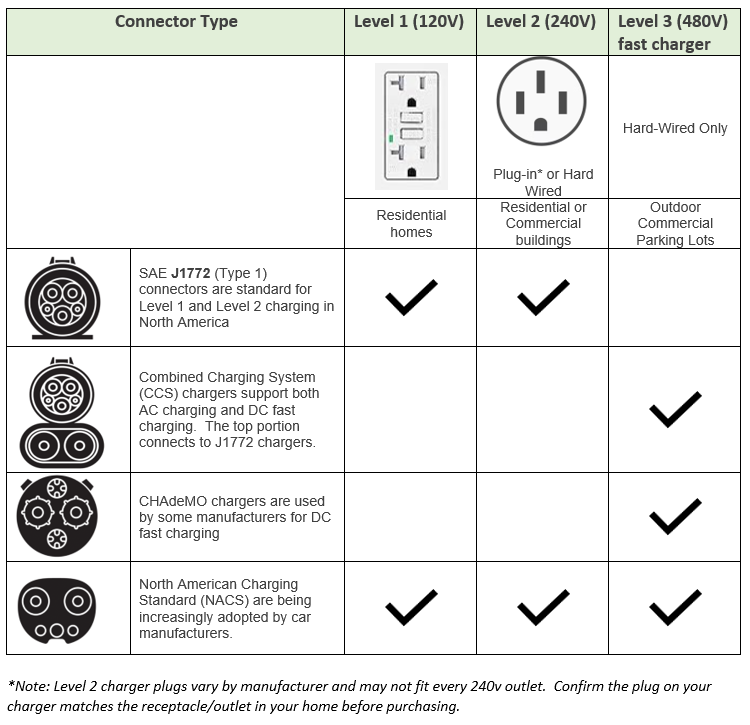
Connector Type & Charging Level
The table below will help you match the connector type on your vehicle with the charging level and associated electrical receptacle in your home or business.
Safe Practices
Safety Requirements
- Electric vehicle supply equipment shall not block any required pedestrian walkways, conflict with adjacent site elements such as bicycle parking, exempt the parking area from any required landscaping, or block vision triangle (that, is obstruct the view of drivers entering or exiting a parking lot.
- When outdoor electric vehicle charging equipment requires electrical distribution equipment, typical with Level 3 chargers, the electrical distribution equipment shall meet the applicable screening requirement of s. 295-405-6. See page 30 for details.
- For projects that required a permit, your electrician will follow the general electrical safety requirements established by the Wisconsin Commercial Building Code for commercial properties or the Uniform Dwelling Code for residential properties, respectively.
- Enclosure Weatherproofing: Electric vehicle charging systems with receptacles installed in a wet location will be required to have a weatherproof enclosure that fully closes whether the cord is plugged into the receptacle or not. The cover will be required to be extra duty rated.
- For commercial Level 2 and Level 3 chargers, a disconnecting method such as an Emergency Stop button shall be installed in a readily accessible location. It shall be capable of being locked in the open position.
Safety Recommendations
- Select Electric Vehicle Supply Equipment (EVSE) that has been UL Listed.
- All receptacles installed for plug-in electric vehicle charging systems are required to have Ground-Fault Circuit Interrupter (GFCI) protection.
- A cord management system should be used to keep chargers tidy and off the ground. Never use extension cords with EV chargers.
- If available, select charging equipment with advanced safety features such as thermal monitoring, ground monitoring, over-current and over-voltage protection, and a de-engergized coupler.
- Hard-wired Level 2 and 3 chargers should be protected with bollards to reduce the risk of collisions.
- Although the risk of electrical fires from charging vehicles is extremely low, electrical vehicle fires are more difficult to extinguish. Charging infrastructure is safest when placed in surface parking lots. If placed in a structure, they should be located either close to the ground level exit or on the top floor of an open-air parking structure.
- Locate chargers on elevated ground or well-drained areas of parking lots to avoid pooling water
- If you have indoor Level 1 or 2 charging in your home garage, the Milwaukee Fire Department recommends adding an outdoor Emergency Shut Off Switch labled "EV Charger Shut Off" to be able to immedately shut off vehicle charging in the event of a fire.