1. Introduction
On June 16, 2020 the Common Council approved File No.200198 authorizing City Administration to implement a temporary outdoor dining program to provide expanded outdoor seating options at restaurants and bars in Milwaukee. The City of Milwaukee has issued requirements applicable to the safe, gradual reopening of restaurants to the public, beginning with outdoor dining. The City of Milwaukee seeks to support small businesses through the safe reopening of restaurants and bars by increasing options for outdoor dining that adhere to local physical distancing requirements in well-ventilated areas.
Beginning June 17, 2020 the Active Streets for Businesses Program allows for the suspension of certain code and permit requirements to allow restaurants to apply for expedited City approval to use the public right-of-way (streets, sidewalks) for flexible outdoor dining areas (“Active Streets for Business”). All outdoor dining areas permitted under this program must comply with state and local health requirements intended to slow or prevent the transmission of COVID-19, including, but not limited to, six-foot separation requirements.
The Active Streets for Businesses Program is a pilot program to be instituted at select locations across the City in coordination with community partners and local businesses. The program will enable the City to gain experience identifying recurring issues for applicants, evaluate relevant traffic safety and circulation issues, and monitor public health effects of the program. If the program is successful, the City anticipates expanding the volume of approved outdoor street dining applications based on demand and safety considerations. Applications are encouraged citywide and will be evaluated on a rolling basis.
2. Overview of Application Process and Approval
Applicants should become familiar with these guidelines prior to submitting an application for the Active Streets for Businesses Program. Permissions for outdoor street dining will be conditioned on compliance with these guidelines and failure to adhere to the guidelines slow the review process and potentially result in denial of the application. Particularly with regard to site plans, it is important that applicants provide detail sufficient to enable City safety and health review.
The City is putting together this program with a sense of urgency and seeking to remove obstacles to outdoor dining areas through a simplified and streamlined permit process. During this time, there is no permit application fee for the Active Streets for Businesses Program, but applicants are responsible for obtaining and installing required traffic barriers as well as other costs of implementing the site plan and complying with the Active Streets for Businesses Program conditions. Applicants for full street closure may also bear additional costs and requirements due to additional City resources required.
The City’s Active Streets for Businesses Program application instructions are online on the City’s website https://city.milwaukee.gov/dpw. The application process can be completed entirely online to allow for electronic routing and permit issuance. Upon approval of the application, the City will email the applicant an approved Active Streets for Businesses Program permit for outdoor street dining and a Temporary Change of Plan Permit that will typically constitute the only permission required for an applicant to proceed with the outdoor street dining area. (Except that in the case of full street closures, additional processes will be required.) Commencement of operations will, in most instances, be subject to a field inspection by the City to verify compliance with required safety and health conditions. In addition, applicants are responsible for complying with City and State liquor licensing requirements.
3. Applicant and Site Eligibility
APPLICANT. Eligible applicants for the Active Streets for Businesses Program must, at minimum:
- Hold a valid certificate of occupancy and food or alcohol dealer license for restaurant or bar operations adjacent to the area proposed for outdoor dining;
- Complete the City’s online application;
- Attach a site plan to the application with the proposed layout of the outdoor street dining area in accordance with the requirements set forth in Sections 4 and 5 below;
- Agree to the City’s terms and conditions set forth in Exhibit A, below, including insurance;
- Obtain required City or State liquor license approvals (if serving alcohol in the outdoor street dining area);
SITE. Certain sites/locations may not be eligible for use as outdoor street dining due to safety, public health, or transportation reasons.
The following factors will be evaluated in determining eligibility. City staff may suggest measures to address concerns, but the City reserves in its sole discretion the ability to deny an application for one or more of the following reasons:
- Location unsafe due to traffic speed (sites adjacent to streets with posted speed limits above 25 mph are not eligible), poor visibility, narrow street (lack of buffer), or other safety issue related to proximity of motor vehicle traffic;
- Location required for traffic circulation reasons;
- dverse impacts on fire lanes, hydrant access, or other emergency vehicle response;
- Interference with access to private property (driveways, delivery/loading zones);
- Inability to maintain a required minimum clear path of travel for sidewalk users;
- Inability to ensure adequate spacing of customers within proposed area;
- Impacts to Milwaukee County Transit Service;
- Whether the use would facilitate a public or private nuisance or create undesirable neighborhood problems such as disorderly patrons, unreasonably loud noise, litter, or any other factor which reasonably relates to the public health, safety, and welfare;
- The applicant’s record in operating similarly licensed premises;
- Aldermanic approval for closures related to travel lanes;
- The City retains full authority in its sole discretion to deny applications for outdoor street dining. An explanation of the denial will be provided along with any mitigation or conditions that make the site eligible.
4. Site Plan
As part of the online application process, the applicant must upload a detailed Site Plan. The
Site Plan must meet the following general requirements:
- Include full dimensions showing location and the length/width of the proposed area. For sidewalk and curb lane seating areas, include location and dimensions to the curb and property line and to all poles, driveways, hydrants, trash cans, street trees, curb ramps etc.
- The width of the outdoor seating area shall not exceed the width of sidewalk frontage of the applicant’s property. The applicant’s perimeter must be clearly defined with barriers, fencing, ropes or other means to clearly identify the outdoor space.
- Outdoor facilities, including railing post supports (feet/base) or planters, must be placed to provide at least a six-foot-wide area of continuous unobstructed walking space. This area must be free from curbs, poles, fire hydrants, pull boxes, news racks, tree wells, curb ramps etc. In areas of high pedestrian use, the minimum unobstructed width may be greater.
- The tables, chairs and removable barriers must never restrict the clear path of egress from the main entrance or from egress paths of the adjacent properties to the sidewalk. Curb ramps must not be restricted.
- Tables, chairs and umbrellas are permitted.
- Tent structures, heaters, electric, lighting etc. are not permitted.
- Indicate the distance of the applicant’s facility to the proposed seating area if not adjacent to building frontage.
- Include any potential impacts that your proposed outdoor seating would have on the functions of other buildings, showing any doors, stairs and/or fire escapes.
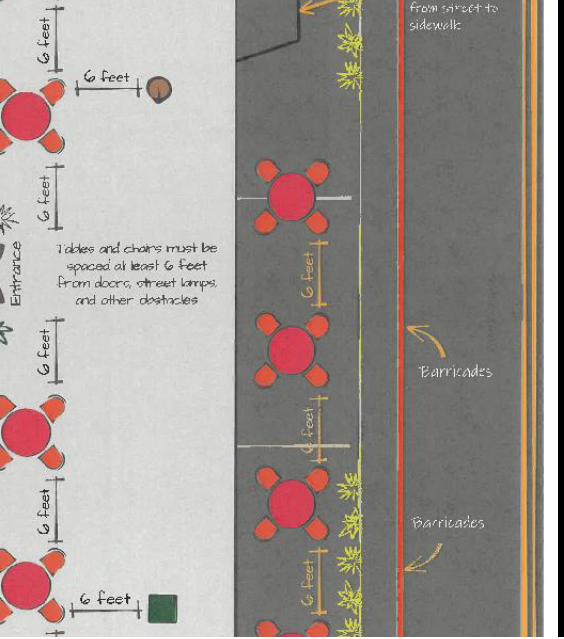
- List quantity of tables and seats and proposed layout (note that chair-backs from separate parties must be at least 6’ apart).
- Show location of ramps to be installed if needed to provide accessible seating at street elevation.
- If unsafe pedestrian congestion results from the reduced walking space, this permit will be revoked.
- If tables are in the street, the Site Plan must include accessibility from sidewalk to the street elevation.
- 13. Outdoor street dining areas must be cleaned and maintained daily by applicant – in addition to COVID-19 cleaning requirements in between customer use.
- No drilling, adhesives or attachments are permitted in the street or sidewalk.
- Hours of operation, set up, and tear down are to be determined by the business owner, subject to Active Streets for Businesses Program hours of operation limits. Outdoor street dining areas may be operated until no later than 10PM Sunday - Thursday and 12AM on Friday and Saturday. These times may be altered by local council members.
- Food storage and food preparation are prohibited in the outdoor street dining area.
- No music or live bands will be permitted in the expanded dining area
- At no time shall the number of occupants exceed the reduced restroom capacity limits determined by the City of Milwaukee Health Department and defined in Chapter 29 of the “International Building Code.”
- Additional outdoor capacities limits will be determined by the City of Milwaukee Health Department reduction requirements as it relates to the “Maximum Floor Area Allowances per Occupant” in Chapter 10 of the “International Building Code.”
- Capacity signage will be required to be posted in outdoor dining areas.
- Outdoor expanded spaces shall not be used for waiting or staging areas.
In addition to #1-21 above, the following guidelines apply to outdoor street dining space in the curb lane. The below requirements do not apply to sites outside the street.
- Size allowable – curb lane widths vary. Allowable seating area in a curb lane is approximately 6 feet wide depending on the existing curb lane width, barrier width and a 1’ buffer if necessary. If business frontage abuts more than two parking spaces, additional parking spaces may be considered.
- Barricades around proposed seating area are required.
- Wheel stops at adjacent on-street parking spaces are required.
- Reflective tape on barricades is required to improve visibility.
- Storm water inlets must remain open.
In the event of a full street closure, the following guidelines apply in addition to all relevant requirements listed above. The City will contact the applicant to discuss additional steps necessary to petition for street closure.
- Size allowable– building front footage times half roadway width. Outdoor dining area should be adjacent to the business frontage.
- Barricades for the street closure are required. Applicant must submit proposed barricade type.
- Reflective tape on barricades is required to improve visibility.
- Storm water inlets must remain open.
Terms and Conditions
GENERAL TERMS AND CONDITIONS. Applicants must comply with the General Terms and Conditions attached as Exhibit A. In addition, applicant must acknowledge that the permit is a revocable license authorizing temporary, revocable permissions to operate an outdoor dining area. This order does not create a private right to occupy the public right-of-way or diminish the Department of Public Works Commissioner the authority to oversee and manage the public right-of-way in the City’s best interests. This Active Streets for Businesses Program is subject to modification or revocation at the City’s sole discretion.
OPERATING TERMS AND CONDITIONS. The applicant shall agree to the following:
- Applicant agrees to comply with and enforce customer compliance with the City and state’s requirements for restaurant and bar operation, a copy of which is attached as Exhibit B, including by refusal of service to customers that do not comply with City and State public health orders.
- Applicant acknowledges that the application will be rejected or the permit withdrawn if the City in its sole discretion determines that the site presents significant safety or traffic circulation concerns.
- Applicant agrees that it will be responsible for coordinating any issues or permissions required from valet parking operators or curbside pick-up operations affected by the proposed site.
- Applicant agrees that animals are not permitted at the site except as required for persons with disabilities (i.e., as accommodations under the Americans with Disabilities Act).
- Applicant agrees that it will comply with all required liquor laws and be responsible for coordinating compliance with applicable local and state authorities.
- Applicant agrees that no food preparation or food storage shall occur in the outdoor dining area.
Exhibit A – General Terms and Conditions
Each applicant receiving permission to establish outdoor street dining in the right-of-way (“Permittee”) agrees to abide by the following terms and conditions of approval:
- COVID-19 Health Requirements and Other Standard Conditions. The Permittee shall comply and further shall cause its employees, agents, guests, invitees, and contractors to comply with all state and local orders addressing public health and physical distancing, including any joint orders issued by the Mayor of the City of Milwaukee and the City of Milwaukee Health Department concerning the establishment of outdoor street dining in the right-of-way.
In addition, the Permittee shall comply and further shall cause its employees, agents, guests, invitees, and contractors to comply with these terms and conditions and any other rules or regulations established by the City of Milwaukee (“City”) concerning the establishment of outdoor street dining space in the right- of-way, which the City may modify or supplement in order to protect and promote the public health, safety, and welfare.
- Expenses. All expenses associated with the Permittee’s establishment and operation of outdoor street dining in the right-of-way shall be borne by Permittee. The City shall not be responsible for any costs associated with the Permittee’s establishment and operation of outdoor street dining in the right-of-way.
- Establishment of Outdoor Street Dining Area. In establishing outdoor street dining in the right-of- way, Permittee shall not cause modify, alter, or demolish existing curbs, sidewalks, streets or other encroachments within or near the right-of-way or attach furniture or other fixtures using fasteners, adhesives, or other invasive means, unless specifically approved by the City as part of the City’s approval of the Permittee’s plans.
- Maintenance of Outdoor Street Dining or Retail Areas. Following the Permittee’s establishment and operation of outdoor street dining or retail in the right-of-way, Permittee shall maintain the area in good, clean, and safe condition and repair and in accordance with applicable City rules and regulations. If the City determines that the outdoor street dining poses a hazardous condition, has caused damage to City property, or is otherwise not being properly maintained, the City may require Permittee to immediately take such action as is necessary to rectify the situation to the City’s satisfaction. If Permittee fails to correct the identified hazardous condition, improper maintenance, damage, or other problem caused by the outdoor street dining, the City may do so; whereupon Permittee shall pay all costs incurred by the City, together with interest thereon from the date that the City pays or incurs such costs at a reasonable rate of interest determined by the City, within 24 hours after the City’s demand.
- City’s Right to Enter upon Right-of-Way Property. Permittee acknowledges that the City and its authorized representatives have the unlimited right to enter upon the right-of-way at any time for any purpose, including without limitation to inspect the right-of-way and permitted encroachments; provided, however, the City shall have no duty to inspect.
- Rights of Utility Companies. All rights herein granted to Permittee to establish and operate outdoor street dining space in the right-of-way are subject and subordinate to the rights of any and all utility companies that may now or hereafter have utility lines and/or other utility installations within the right-of- way. Permittee shall not alter, relocate, or otherwise interfere with such utility lines and installations and shall not do anything that will impair such utility companies’ right to enter upon the right-of-way for all purposes associated with the operation, maintenance, repair, replacement or removal of such utility lines and installations. Permittee shall ensure that such utility companies have continued access to the subject area, 24 hours per day, 7 days per week, 52 weeks per year.
- Insurance. During the period in which this revocable privilege is in effect, Permittee shall maintain a policy of General Liability insurance with respect to the right-of-way and the outdoor street dining in an amount not less than One Million Dollars per occurrence, combined single limit, naming the City as an additional insured. Permittee shall furnish to the City a certificate of insurance evidencing such insurance prior to commencing construction of Permittee’s permitted encroachments, unless otherwise authorized by the City.
- Waiver of Claims for Damage. The City shall have no responsibility or liability for loss or damage to any permitted encroachments or theft of any permitted encroachments or any items of personal property that may at any time be on the right-of-way, including without limitation damage caused by the general public, trespassers, graffiti, thrown objects, wind, hail, fire, or other casualty, no matter how such damage is caused. As a material inducement to the City to grant this outdoor street dining privilege, Permittee hereby waives, as against the City and its employees, agents, guests, invitees, and contractors, all claims and liability, and on behalf of Permittee’s insurers, rights of subrogation, with respect to property damaged or destroyed by fire or other casualty or any other cause, no matter how caused.
- Indemnification. Permittee shall indemnify, defend, and save the City, its employees, agents, and contractors harmless from and against any and all losses, damages, settlements, costs, charges professional fees, and other expenses and liabilities of every kind and character (including without limitation attorney fees) arising out of or related to any and all claims, liens, demands, obligations, actions, proceedings, or causes of action of every kind and character in connection with Permittee’s establishment and operation of outdoor street dining in the right-of-way, use of the right-of-way, or violation of the provisions set forth in this outdoor dining privilege, including without limitation any of the foregoing that may arise or be claimed with respect to any death, personal injury, or loss of or damage to property on or about the right-of-way. Permittee shall assume the defense (with counsel acceptable to the City) and settlement of any and all such suits or other legal proceedings brought against the City and shall pay all judgments entered in such suits or other legal proceedings. The assumption of liability and indemnity obligations of Permittee under this outdoor dining privilege shall survive the termination of this outdoor dining privilege with respect to matters arising prior thereto.
- Compliance with all applicable laws. Permittee shall at all times maintain compliance with all applicable federal, state and local laws, regulations, ordinances, or other rules.
- Adverse impacts on adjacent properties. Permittee shall undertake all reasonable efforts to avoid undue adverse impacts to adjacent properties and/or uses that may arise from the construction, operation, maintenance, modification, or removal of the permitted encroachments.
- Accessibility. Permission for outdoor street dining space in the right-of-way shall be conditioned on maintenance of accessible conditions along the sidewalk adjacent to the outdoor dining area. Permittee shall maintain a minimum path of travel along the sidewalk area of at least 72” in width at all points adjacent to the outdoor dining area.
- City’s Right to Revoke. The City shall have the right to revoke this outdoor dining privilege, for any reason, upon 24 hours prior written notice to Permittee. Within such 24-hour period, and unless otherwise agreed to by the City, Permittee shall remove the permitted encroachment and restore the right-of-way to a condition that is acceptable to the City.
- Obligation to Remove Permitted encroachment. If Permittee fails to timely remove the permitted encroachment and restore the right-of-way as required under this outdoor dining privilege, the City may do so at Permittee’s expense. All obligations of Permittee hereunder that have accrued but have not been fully performed as of the effective date of the termination of this outdoor dining privilege shall survive such termination until fully performed.
- Transfer of Permittee’s Property: This outdoor dining privilege is personal to Permittee, shall not inure to the benefit of Permittee’s successors-in-interest with respect to Permittee’s property, and shall not be recorded in the public records. Permittee shall provide the City thirty (30) days’ prior written notice of its intent to close on the sale or transfer of Permittee’s property. UponPermittee’s sale or transfer of Permittee’s property, this outdoor dining privilege shall automatically terminate. Prior to the closing on any such sale or transfer, unless the City has granted, and the purchaser or transferee has accepted, an outdoor dining privilege for the permitted encroachments to take effect upon closing, Permittee shall remove the permitted encroachments and restore the right-of-way to a condition that is acceptable to the City.
Exhibit B- City Health Requirements for Operation of Restaurants and Bars
See Health Department Website: https://city.milwaukee.gov/MovingMKEForwardFullTable
Exhibit C – Plan Example