


Food Safety: Juice Requirements
MHD's juice guidance and requirements help protect public health, maintain compliance with state and federal regulations, and promote confidence in the products offered by Milwaukee’s vibrant retail beverage community.
Fresh, unpasteurized juice continues to grow in popularity across Milwaukee, and ensuring its safety is essential for both consumers and businesses. To support local businesses and community members, the Milwaukee Health Department (MHD) has developed clear guidance on how juice should be properly produced, labeled, and sold within the city.
Fresh Juice at Retail
Juice sold at retail should be either:
• made yourself at retail –OR– received prepackaged, labeled, and produced under a HACCP
→ Made yourself at retail
Juice produced at retail requires a warning label. Label the juice with the warning label below.
|
WARNING: This product has not been pasteurized and, therefore, may |
→ Received prepackaged, labeled, and produced under a HACCP from another manufacturer
Methods of Sale
Retail onsite sales – immediate, made to order service
→ Does not require product labeling nor warning label
Retail onsite sales – packaged
→ Warning label required & package labeling required. Product label shall include product name, list of ingredients, allergen statement, net weight, business name, address, and phone number. See Retail Labeling Requirements Fact Sheet for more information.
Datemarking
Citrus juices do not require datemarking; the acidic environment does not support pathogen growth. Other juices such as vegetable, melon, cantaloupe, and other neutral pH produce that are considered TCS (time-temperature control safety) require a 7-day datemark.
Product Testing
A Product Testing is an evaluation of a food product to determine if it is TCS or non-TCS. An operator may choose to do this if they believe their product is non-TCS and therefore datemarking and refrigeration should not apply for safety. If the product is deemed non-TCS this means it does not have a viable environment for pathogens to grow and this has been proven by lab testing. This testing is completed by a private, certified laboratory and paid for entirely by the operator
Guidance to Properly Produce Juice in the City of Milwaukee
Licensing & HACCP Requirements
See FDA's Juice HACCP guidance for more information on requirements. Below are HACCP courses available for industry or retail food operators.
• HACCP training course for operators by DATCP
The following questions will help MHD understand your business plan. Your answers will determine proper licensing & HACCP requirements.
→ Where do you produce your juice? Onsite at an event only, do you utilize a commercial kitchen to pre-make and bottle your juice?
→ Where or how do you sell your product?
→ Do you sell directly to consumers or do you wholesale?
The City of Milwaukee licenses retail or direct to consumer sales; the state of Wisconsin (DATCP) licenses operations with more than 25% wholesale. Any location processing, pressing, juicing or handling ingredients requires a food license.
Wholesale is when one business sells their product to another licensed business to then resell the product. Any amount of wholesale will require a HACCP plan. Why? Because wholesale typically means your product is going further away from your direct supervision and could reach more consumers, therefore the risk is increased. The HACCP reduces this risk by eliminating pathogens of concern. The state of WI DATCP will review your HACCP plan.
Use the flow chart below to determine what licenses are needed and when a HACCP is required.
We also understand that business plans change. If something significant changes in your business operation, call MHD at 414-286-8327 to see if that change calls for any alterations in licenses or HACCP plan.
Historical Background
In 1938 the Federal Food, Drug, Cosmetic Act was enacted. It is “a United States Law that regulates the safety and purity of food, drugs, medical devices, and cosmetics, empowering the FDA to oversee their production, sale, and distribution to protect public health. It was enacted after the deaths of over 100 people from a mass poisoning involving an untested, toxic antibiotic, leading to mandatory pre-market safety testing for new drugs, standards for food and cosmetics, and the ability for the FDA to inspect facilities and seize unsafe products.” (source: www.fda.gov)
From this act, administrative codes were born to manage food safety at different levels of regulation depending on the potential reach of the product. Generally speaking, the Wisconsin Food Code (WFC) is based on the Federal Drug Administration (FDA) Food Code which is influenced by the Code of Federal Regulations (CFR).
Code of Federal Regulations (CFR) → FDA Food Code → Wisconsin Food Code (WFC)
The City of Milwaukee Health Department Consumer Environmental Health follows the WFC to ensure the public’s health related to food and beverage, which reaches back to the CFR for certain rules.
Created in the 1960’s, HACCP [Hazard Analysis and Critical Control Points] is a “preventative food safety management system designed to identify, evaluate, and control food safety hazards from the production of raw materials to the consumption of the finished product. It focuses on preventing potential hazards (biological, chemical, physical) by establishing critical control points in the food chain where risks can be eliminated or reduced to safe levels.” (source: www.fda.gov). Special processes, to name a few, like reduced oxygen packaging, fermentation, curing & smoking, and juicing require a HACCP.
Any amount of wholesaled juice requires a HACCP. Juice requires a HACCP plan to prevent microbial, chemical, and physical contamination because raw produce can contain harmful bacteria that survive the juicing process. The juice must achieve a 5-log reduction of pathogens to ensure safety.
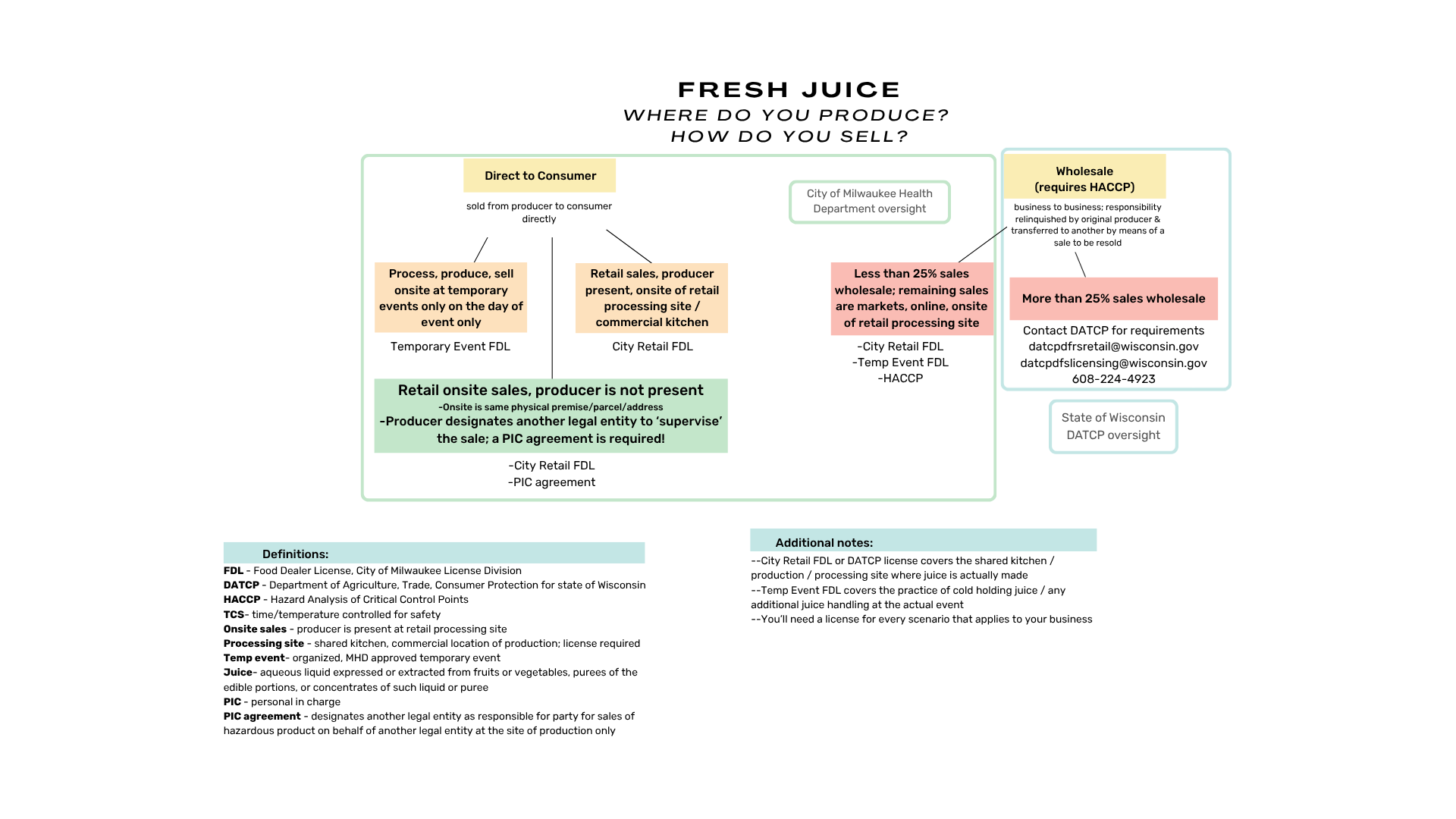
Click the image to enlarge or print
Frequently Asked Questions
What about apple cider, coconut water, kombucha, or lemonade?
Apple Cider – is different. See this DATCP guidance handout.
Coconut water – is just the liquid inside the drupe; if blending the coconut fruit (white flesh inside) with the liquid, now you’re making a juice and shall follow juice guidelines.
Kombucha – is a fermented beverage and will require HACCP and a variance.
Lemonade – is a mixture water and lemon juice. Fresh squeezed lemon juice is a juice and shall follow juicing guidelines. Or you must use a lemon juice that is commercially processed under a manufacturer’s HACCP.
If I boil berries or other fruits in water, is this considered a juice?
Not likely. Boiling berries or fruits to make a shrub for cocktails / mocktails or infused beverages is most likely not considered a juice, however the product is probably TCS due to heat treating the plant product. And ultimately it will depend on your process.
Are there any local laboratories that would perform product testing for me?
Yes. See Commercial Food Safety Labs in Wisconsin.
I heat my juice and bottle while it is hot. Is this a different process?
Yes - this process will require a HACCP and a variance because this is considered a reduced oxygen packaging special process. If your juice is cold when bottled, this is not a special process.