Public Artist in Residence (PAIR) Program
The Milwaukee Arts Board (MAB), in partnership with the Department of City Development (DCD) and Milwaukee Fire Department (MFD), announced Sarah Luther as the City of Milwaukee's 2026-2027 Public Artist in Residence (PAIR). Luther’s residency, which began July 1, 2026, is the second iteration of the City’s PAIR program and will focus on safe housing in Milwaukee.
Under the PAIR program, a local artist is offered a residency within a City of Milwaukee agency or department. The purpose of the residency is to support artistic growth while highlighting creative thinking as a tool for confronting complex civic challenges. PAIR not only brings awareness to these challenges; it positions artistic exploration as a means of empowering communities and individuals. PAIR is committed to supporting artistic excellence at the intersection of creative thinking, city dynamics, and departmental processes.
The residency’s focus aligns with Mayor Cavalier Johnson’s designation of 2026 as Milwaukee’s “Year of Housing.”
“The next phase of the Public Artist in Residence program reflects safe, stable housing as the foundation for strong neighborhoods and a thriving city,” Milwaukee Mayor Cavalier Johnson said. “By partnering with the Milwaukee Fire Department, we are approaching housing safety in a way that is creative, community-centered, and proactive. This collaboration recognizes that preventing tragedy and strengthening housing conditions requires visibility and innovation, and this initiative brings all of this together for the benefit of Milwaukee residents.”
“As a public safety agency, the Milwaukee Fire Department came on board to support the Mayor’s ‘Year of Housing’ by hosting the next PAIR to creatively highlight the human right to affordable, safe, and survivable housing,” Milwaukee Fire Chief Aaron Lipski said. “The MFD has provided the PAIR team with a space to work in a shuttered firehouse. In addition, all firehouses will support the PAIR team’s creative ideas to engage neighborhoods as the program evolves. We all seek the same goal of feeling safe and thriving in our neighborhoods; and the MFD is uniformly positioned as anchors in every neighborhood and centrally immersed in every one of the many diverse communities in Milwaukee.”
“Safe housing is a matter of dignity, equity, and public safety. Through the Public Artist in Residence program, we recognize that artists are essential civic partners,” District 6 Alderwoman and Chair of Milwaukee Arts Board Milele A. Coggs said. “We are opening new pathways to engage residents, raising awareness to this critical issue, and addressing the real conditions impacting Milwaukee families.”
Luther brings extensive experience creating interactive projects that invite community participation and conversation. Throughout her residency, she will use these approaches to explore how artistic practice can create new opportunities for Milwaukee residents to engage with the issue of safe housing.
“The opportunity to use my public art practice in partnership with the Milwaukee Fire Department and the City of Milwaukee is truly an honor” Public Artist in Residence Sarah Luther said. “At the heart of public art making is community voice, engagement, and collaboration. The barriers to safe and healthy housing look different throughout Milwaukee. Using neighborhood fire stations as a hub for connection provides an opportunity to explore housing at a hyper-local level. Throughout the next phase of the project, I look forward to learning from communities and working to create space for people to come together, ask questions, and imagine possibilities that might not emerge through traditional conversations.”
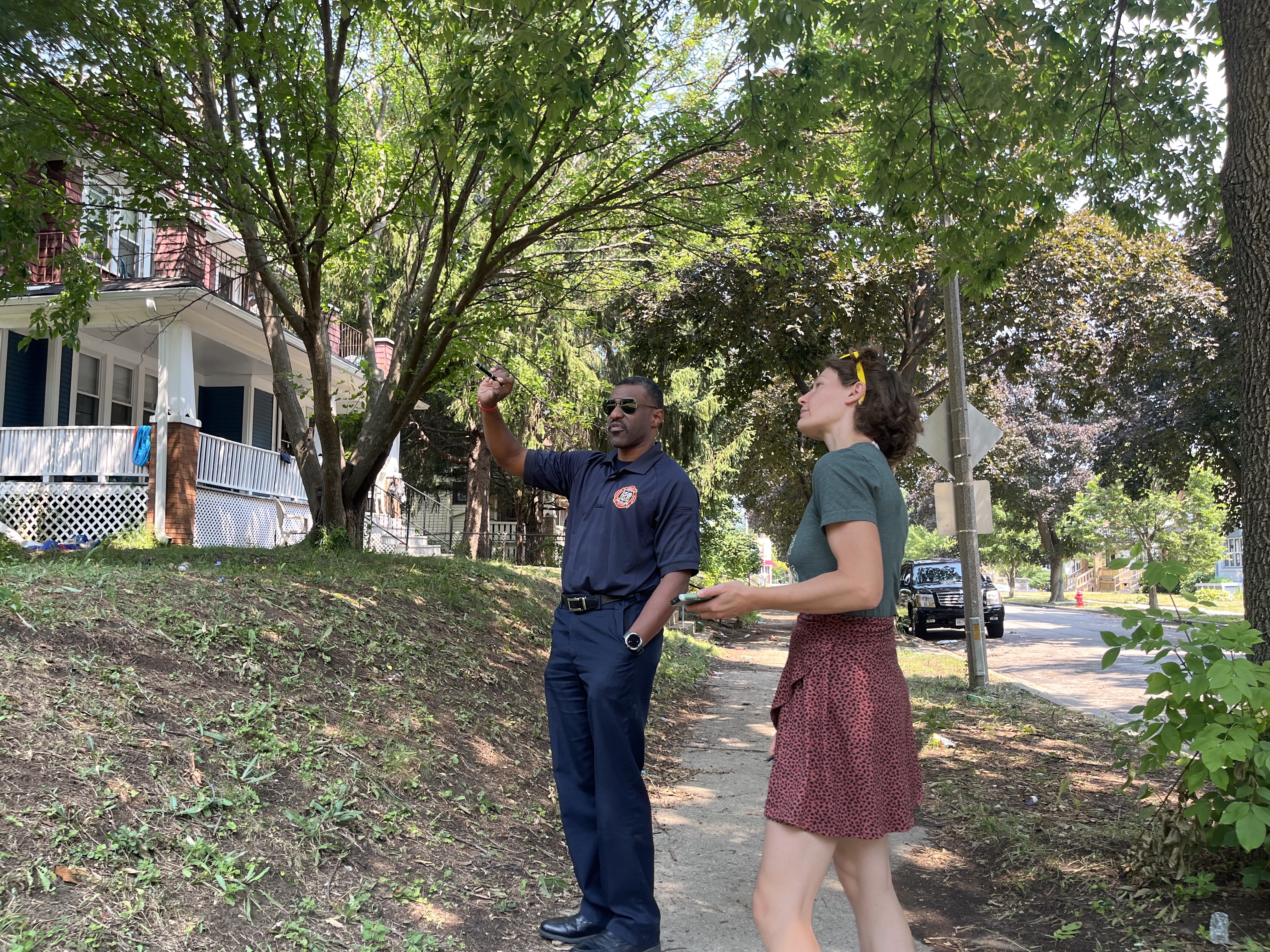
MFD has provided Luther with studio space at Engine House 25, which will serve as an anchor for upcoming residency activities. Luther is currently using the space to conduct studio visits and meet with a range of people interested in safe housing and the intersection of art and civic structures.
The PAIR program is currently in phase one of four, focused on learning, immersion, and research. Luther is spending the first phase learning about MFD, its work, and the communities it serves while conducting extensive field research. Phase two will begin to bring the residency’s work into communities through interactive events and opportunities for public participation throughout Milwaukee.
Luther will share information about her process and provide opportunities for public participation and input at MilwaukeePAIR.com. Residents and community members are invited to visit the website to learn more about the residency, sign up for real-time updates, and receive invitations to upcoming events and activities.
The position of PAIR Liaison for the residency was awarded to Paul Druecke, who will provide logistical support for the residency, including problem-solving, documentation, and evaluation.
The PAIR budget includes up to $45,000 for the artist’s time and up to $25,000 to realize their project. Additional in-kind resources may be provided by MAB and the host agency. Private funding of $20,000 has been secured to support the PAIR Liaison position.
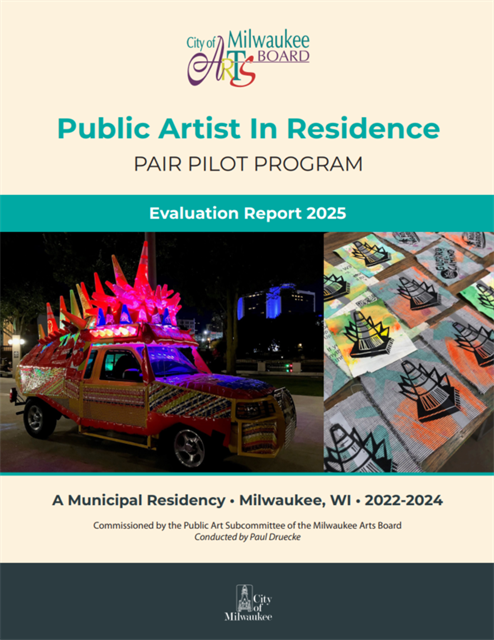
The first PAIR residency took place from 2022-2024 and established the program as the City of Milwaukee’s first municipal interdepartmental artist residency.
City of Milwaukee Arts Board Releases Public Artist in Residence Evaluation Report
The evaluation report analyzes the PAIR Pilot Program based on review of internal documentation as well as news and media coverage. Ten interviews were conducted with a wide range of individuals, most of whom had connections to the program. The report begins with data and selected metrics that provide a statistical overview of the program. The Evaluation Report (ER) focuses on PAIR’s programmatic structure rather than the artwork it produced. The ER’s primary goal is to establish a forward-thinking framework for future PAIR iterations. The report identifies key areas to better understand where the program was successful in delivering on its goals and how it might be improved in future iterations. The report concludes with summary findings and recommendations.
Read the Public Artist In Residence Evaluation Report here
Read the Executive Summary of the Report here